 "I am dismayed. I have no prejudice against violence when I find it in a well-made film. But this film is almost brutally cynical in its approach. The Welsh director, Gareth Evans, knows there's a fanboy audience for his formula, in which special effects amp up the mayhem in senseless carnage. There's obviously an audience for the film, probably a large one. They are content, even eager, to sit in a theater and watch one action figure after another pound and blast one another to death. They require no dialogue, no plot, no characters, no humanity. Have you noticed how cats and dogs will look at a TV screen on which there are things jumping around? It is to that level of the brain's reptilian complex that the film appeals." (Roger Ebert)But is it boring? Hell No.
(*Roger Ebert is
a boring old biddy!)
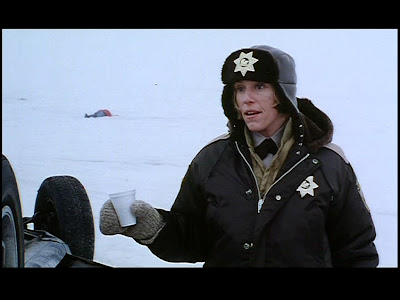 "The Coens are at their clever best with this snowbound film noir, a crazily mundane crime story set in their native Midwest. Purportedly based on real events, it brings them as close as they may ever come -- not very -- to everyday life and ordinary people. Perversely, the frozen north even brings out some uncharacteristic warmth in these coolly cerebral film makers, although anyone seeking the milk of human kindness would be well advised to look elsewhere. The Coens' outlook remains as jaundiced as it was in 'Blood Simple,' the razor-sharp 1984 debut feature that the much more stylish and entertaining 'Fargo' brings to mind." (NY Times)But is it boring? No.
 "Lars von Trier's Dogville gives us America on a soundstage and a Rocky Mountain township rendered in chalk marks on the floor. It is Von Trier's America and Von Trier's township, and this enraged some viewers who dismissed the film as a crude, blinkered diatribe from a man too timid (on account of his aversion to air travel) to actually visit the country for himself. And yes, Dogville is crude and arguably blinkered as well. But it is also electrifying, gripping and audacious: the work of a director at the peak of his powers." (The Guardian)But is it boring? No.
 "The images Mr. Haneke puts on screen (they are shot with crisp, glossy-magazine elegance by Darius Khondji) are shocking, but they don’t unfold with the usual slasher-movie jolts of grisliness. The camera frequently stands still as the horror unfolds just beyond its range, and when a bloody event takes place, we are likely to be shown the face of a passive witness rather than that of the perpetrator or the victim." (NY Times)But is it boring? No.
 "Maybe 'Brick' is a comedy. There is something cute, if not outright ludicrous, in the spectacle of dewy young actors striking the poses of hard-boiled demimondaines and desperadoes and failing utterly to make them come alive. The movie seems to have its tongue stuck in its cheek during a final showdown in a suburban basement, during which the impervious mother of a teenage drug lord is upstairs baking cookies. But funny it's not." (NY Times)But is it boring? No.
 "Since these questions are being pondered by a master surrealist re-examining his own obsessions and personal iconography, 'Mulholland Drive' ranks alongside Fellini's '8 1/2' and other auteurist fantasias as a monumental self-reflection.
Looked at lightly, it is the grandest and silliest cinematic carnival to come along in quite some time: a lurching journey through one filmmaker's personal fun house. On a more serious level, its investigation into the power of movies pierces a void from which you can hear the screams of a ravenous demon whose appetites can never be slaked." (NY Times)But is it boring? No.

"This is the movie that proves Tarantino is the real thing, and not just a two-film wonder boy. It's not a retread of 'Reservoir Dogs' or 'Pulp Fiction,' but a new film in a new style, and it evokes the particular magic of Elmore Leonard--who elevates the crime novel to a form of sociological comedy. There is a scene here that involves the ex-con Louis (Robert De Niro) and Ordell's druggie mistress (Bridget Fonda) discussing a photograph pinned to the wall, and it's so perfectly written, timed and played that I applauded it."But is it boring? No.
 "It's a shaggy ghost story, an exercise in style, a film made with a certain breezy contempt for audiences. I've seen it twice, hoping to make sense of it. There is no sense to be made of it. To try is to miss the point. What you see is all you get." (Roger Ebert)But is it boring? Yes.
 "This apocalyptic nightmare, a vigorous work of dark, surprise-filled science fiction, is much tougher and less fanciful than the director's films have often been. Mr. Gilliam usually writes his own screenplays, but the contributions of a writer (David Peoples) whose credits include 'Unforgiven' and 'Blade Runner' may have something to do with a leaner style." (NY Times)But is it boring? No.

"Tarantino is too gifted a filmmaker to make a boring (!!!!!) movie, but he could possibly make a bad one: Like Edward D. Wood Jr., proclaimed the Worst Director of All Time, he's in love with every shot - intoxicated with the very act of making a movie. It's that very lack of caution and introspection that makes 'Pulp Fiction' crackle like an ozone generator: Here's a director who's been let loose inside the toy store, and wants to play all night." (Roger Ebert)But is it boring? Hell no.
 "Though small in physical scope, 'Reservoir Dogs' is immensely complicated in its structure, which for the most part works with breathtaking effect. Mr. Tarantino uses chapter headings ("Mr. Blonde," "Mr. Orange," etc.) to introduce the flashbacks, which burden the film with literary affectations it doesn't need. Yet the flashbacks themselves never have the effect of interrupting the flow of the action. Mr. Tarantino not only can write superb dialogue, but he also has a firm grasp of narrative construction. The audience learns the identity of the squealer about mid-way through, but the effect is to increase tension rather than diminish it." (NY Times)But is it boring? No.

"'Miller's Crossing' comes from two traditions that sometimes overlap, the gangster movie of the 1930s and the film noir of the 1940s. It finds its characters in the first and its visual style in the second, but the visuals lack a certain stylish tackiness that film noir sometimes had. They're in good taste. The plot is as simple as an old gangster movie, but it takes us a long time to figure that out, because the first half hour of the film involves the characters in complicated dialogue where they talk about a lot of people we haven't met, and refer to a lot of possibilities we don't understand. It's the kind of movie you have to figure out in hindsight." (Roger Ebert)But is it boring? No.

"'Blue Velvet' contains scenes of such raw emotional energy that it's easy to understand why some critics have hailed it as a masterpiece. A film this painful and wounding has to be given special consideration." (Roger Ebert)
But is it boring? No.

"When the explanations do start coming, you may feel that "Marathon Man" is a kind of thriller that has run its course. High-level conspiracies really aren't that interesting unless we can get a fix on who is doing what to whom, which is never clear here. Yet the individual details of "Marathon Man," the performances, and the attention given to its physical settings—in New York, Paris and South America—keep one's belief willingly suspended by a wickedly thin thread." (NY Times)
But is it boring? Yes.


