 "I am dismayed. I have no prejudice against violence when I find it in a well-made film. But this film is almost brutally cynical in its approach. The Welsh director, Gareth Evans, knows there's a fanboy audience for his formula, in which special effects amp up the mayhem in senseless carnage. There's obviously an audience for the film, probably a large one. They are content, even eager, to sit in a theater and watch one action figure after another pound and blast one another to death. They require no dialogue, no plot, no characters, no humanity. Have you noticed how cats and dogs will look at a TV screen on which there are things jumping around? It is to that level of the brain's reptilian complex that the film appeals." (Roger Ebert)But is it boring? Hell No.
 (*Roger Ebert is
a boring old biddy!)
 "By now everybody knows that Ryan O'Neal and his real-life daughter, Tatum, play the man and the girl. But I wonder how many moviegoers will be prepared for the astonishing confidence and depth that Tatum brings to what's really the starring role. I'd heard about how good she was supposed to be, but I nevertheless expected a kind of clever cuteness, like we got from Shirley Temple or young Elizabeth Taylor. Not at all. Tatum O'Neal creates a character out of thin air, makes us watch her every moment and literally makes the movie work (in the sense that this key role had to be well played)." (Roger Ebert)But is it boring? No.
 "'Kiss Kiss, Bang Bang' is made for a fairly specific audience; it helps if you are familiar with the private eye genre in general and the works of Raymond Chandler in particular (the movie has five chapter headings, all taken from Chandler's titles). But do the titles come from Harry Lockhart, or do they exist outside his mind and suggest that Shane Black's screenplay has another level of comment on top? That would be roughly like the subtitles in 'Domino,' which have a different point of view than the narration." (Roger Ebert)But is it boring? No.
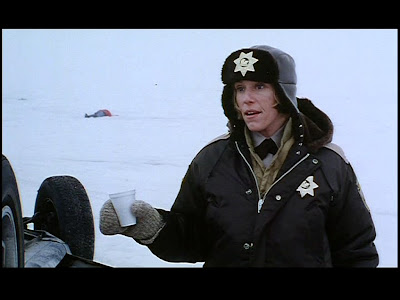 "The Coens are at their clever best with this snowbound film noir, a crazily mundane crime story set in their native Midwest. Purportedly based on real events, it brings them as close as they may ever come -- not very -- to everyday life and ordinary people. Perversely, the frozen north even brings out some uncharacteristic warmth in these coolly cerebral film makers, although anyone seeking the milk of human kindness would be well advised to look elsewhere. The Coens' outlook remains as jaundiced as it was in 'Blood Simple,' the razor-sharp 1984 debut feature that the much more stylish and entertaining 'Fargo' brings to mind." (NY Times)But is it boring? No.
 "It’s critical boilerplate to say that the best narrative art creates a world. But the world of 'Twin Peaks' is a truly rich and commodious one, attentive both to narrative mythology and to character back story, suited equally to the scrutiny of fanzines and dissertations. At its best the show achieved a crazy, cosmic harmony, setting the comforts of the everyday against the terror of the void. The great unifying element is Mr. MacLachlan’s superbly unflappable performance, a witty distillation of the Eagle Scout qualities often ascribed to Mr. Lynch (whose cameos as Cooper’s hearing-impaired boss provide some of the funniest scenes)." (NY Times)But is it boring? Yes.
 "Thomson wrote that this film is 'so tough that its impassive romanticism is not just fascinating, but nearly comic.' Some of the comic details are so quiet they could be missed. Consider the bird in Costello's drab hotel room. It is a gray, shabby bird (of course) with an unpleasant chirp. Why would this man have a bird? Is it even his? Did it come with the room? The bird's chirp provides an amusing payoff after the cops wire the room and set up a tape recorder that records only . . . chirps, for a while. Apart from the bird, the room contains the following personal possessions of Costello: His trench coat, his fedora, his pack of cigarettes, and a bottle of mineral water. At one point, he walks over to an armoire, and on top of it, I was delighted to see, were rows of water bottles and neatly arranged packs of cigarettes. You smile because such details are a very quiet wink from Melville, telling you he knows what he's up to." (Roger Ebert)But is it boring? Yes.
 "Vincent Cassel is the overwhelming fact of both films. He doesn't give Mesrine great depth, because how can he? The man was a psychopath, immune to movie psychology. But he gives him great presence. He is brutal, ugly, powerful and inscrutable. In other roles he's none of those things; he looks nice when he smiles. But he finds such cold ferocity in Mesrine that he's like a wild animal who kills for survival. I don't think Mesrine likes killing. He just frequently has to." (Roger Ebert)But is it boring? Yes.
 "The build-up to this slaying forms the opening scene to Jean-François Richet's terrific film, though the sequence is presented in a tricksy split-screen manner, misleadingly hinting that the film will be in the wacky Anglo-Saxon style of The Italian Job or The Thomas Crown Affair. Instead, Mesrine is in the tradition of Jules Dassin's Rififi or Jean-Pierre Melville's Le Cercle Rouge: muscular, forthright storytelling, hard-smoking, hard-drinking action, horribly incorrect attitudes, brutality with a top-note of self-loathing, bushy moustaches and a cracking lead performance from Vincent Cassel as Mesrine." (The Guardian)But is it boring? No.
 "The images Mr. Haneke puts on screen (they are shot with crisp, glossy-magazine elegance by Darius Khondji) are shocking, but they don’t unfold with the usual slasher-movie jolts of grisliness. The camera frequently stands still as the horror unfolds just beyond its range, and when a bloody event takes place, we are likely to be shown the face of a passive witness rather than that of the perpetrator or the victim." (NY Times)But is it boring? No.
 "Brilliantly adapted from James Ellroy's near-unfilmable cult novel, it casts anything-but-A-list stars (yet) in a story with three leading men, no two of whom can be construed as buddies. It embroils them in a cliche-free, vigorously surprising tale that qualifies as true mystery rather than arbitrary thriller and that revels in its endless complications. Take a popcorn break and you'll be sorry." (NY Times)But is it boring? No.

"This is the movie that proves Tarantino is the real thing, and not just a two-film wonder boy. It's not a retread of 'Reservoir Dogs' or 'Pulp Fiction,' but a new film in a new style, and it evokes the particular magic of Elmore Leonard--who elevates the crime novel to a form of sociological comedy. There is a scene here that involves the ex-con Louis (Robert De Niro) and Ordell's druggie mistress (Bridget Fonda) discussing a photograph pinned to the wall, and it's so perfectly written, timed and played that I applauded it."But is it boring? No.

"'Fallen Angels' certainly abounds in visual pizazz, clever in jokes and trendy pop references, but such things can carry a movie only so far." (NY Times)But is it boring? No.

"The story builds up to a blinding revelation, which shifts the nature of all that has gone before, and the surprise filled me not with delight but with the feeling that the writer, Christopher McQuarrie, and the director, Bryan Singer, would have been better off unraveling their carefully knit sleeve of fiction and just telling us a story about their characters - those that are real, in any event. I prefer to be amazed by motivation, not manipulation." (Roger Ebert)But is it boring? No.

"Tarantino is too gifted a filmmaker to make a boring (!!!!!) movie, but he could possibly make a bad one: Like Edward D. Wood Jr., proclaimed the Worst Director of All Time, he's in love with every shot - intoxicated with the very act of making a movie. It's that very lack of caution and introspection that makes 'Pulp Fiction' crackle like an ozone generator: Here's a director who's been let loose inside the toy store, and wants to play all night." (Roger Ebert)But is it boring? Hell no.
 "Though small in physical scope, 'Reservoir Dogs' is immensely complicated in its structure, which for the most part works with breathtaking effect. Mr. Tarantino uses chapter headings ("Mr. Blonde," "Mr. Orange," etc.) to introduce the flashbacks, which burden the film with literary affectations it doesn't need. Yet the flashbacks themselves never have the effect of interrupting the flow of the action. Mr. Tarantino not only can write superb dialogue, but he also has a firm grasp of narrative construction. The audience learns the identity of the squealer about mid-way through, but the effect is to increase tension rather than diminish it." (NY Times)But is it boring? No.

"'Miller's Crossing' comes from two traditions that sometimes overlap, the gangster movie of the 1930s and the film noir of the 1940s. It finds its characters in the first and its visual style in the second, but the visuals lack a certain stylish tackiness that film noir sometimes had. They're in good taste. The plot is as simple as an old gangster movie, but it takes us a long time to figure that out, because the first half hour of the film involves the characters in complicated dialogue where they talk about a lot of people we haven't met, and refer to a lot of possibilities we don't understand. It's the kind of movie you have to figure out in hindsight." (Roger Ebert)But is it boring? No.

"'Blue Velvet' contains scenes of such raw emotional energy that it's easy to understand why some critics have hailed it as a masterpiece. A film this painful and wounding has to be given special consideration." (Roger Ebert)
But is it boring? No.


