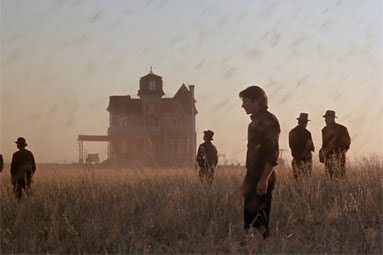
"Terence Malick's 'Days of Heaven' has been praised for its painterly images and evocative score, but criticized for its muted emotions: Although passions erupt in a deadly love triangle, all the feelings are somehow held at arm's length. This observation is true enough, if you think only about the actions of the adults in the story. But watching this 1978 film again recently, I was struck more than ever with the conviction that this is the story of a teenage girl, told by her, and its subject is the way that hope and cheer have been beaten down in her heart. We do not feel the full passion of the adults because it is not her passion: It is seen at a distance, as a phenomenon, like the weather, or the plague of grasshoppers that signals the beginning of the end." (Roger Ebert)But is it boring? Yes.
 "By now everybody knows that Ryan O'Neal and his real-life daughter, Tatum, play the man and the girl. But I wonder how many moviegoers will be prepared for the astonishing confidence and depth that Tatum brings to what's really the starring role. I'd heard about how good she was supposed to be, but I nevertheless expected a kind of clever cuteness, like we got from Shirley Temple or young Elizabeth Taylor. Not at all. Tatum O'Neal creates a character out of thin air, makes us watch her every moment and literally makes the movie work (in the sense that this key role had to be well played)." (Roger Ebert)But is it boring? No.
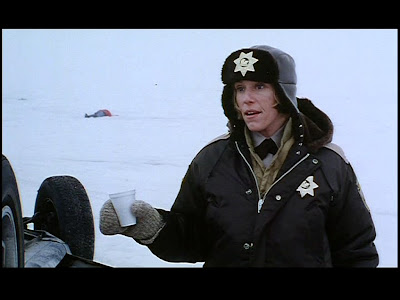 "The Coens are at their clever best with this snowbound film noir, a crazily mundane crime story set in their native Midwest. Purportedly based on real events, it brings them as close as they may ever come -- not very -- to everyday life and ordinary people. Perversely, the frozen north even brings out some uncharacteristic warmth in these coolly cerebral film makers, although anyone seeking the milk of human kindness would be well advised to look elsewhere. The Coens' outlook remains as jaundiced as it was in 'Blood Simple,' the razor-sharp 1984 debut feature that the much more stylish and entertaining 'Fargo' brings to mind." (NY Times)But is it boring? No.
 "Lars von Trier's Dogville gives us America on a soundstage and a Rocky Mountain township rendered in chalk marks on the floor. It is Von Trier's America and Von Trier's township, and this enraged some viewers who dismissed the film as a crude, blinkered diatribe from a man too timid (on account of his aversion to air travel) to actually visit the country for himself. And yes, Dogville is crude and arguably blinkered as well. But it is also electrifying, gripping and audacious: the work of a director at the peak of his powers." (The Guardian)But is it boring? No.
 "The time is the late 1950's, the place the Paradise, a failing Italian restaurant in New York run by two irresistible brothers. Both are fiercely proud, and their culinary relationship is so close that each has opinions about how the other minces garlic or wields a salt shaker. Secondo (Mr. Tucci) is the front man, debonair and impeccable, humoring the few boorish customers that the restaurant is able to lure. As his name suggests, Primo (Tony Shalhoub) is the artist, hiding himself in the kitchen and muttering about crimes like 'the rape of cuisine.'"(NY Times)But is it boring? No.
 "It’s critical boilerplate to say that the best narrative art creates a world. But the world of 'Twin Peaks' is a truly rich and commodious one, attentive both to narrative mythology and to character back story, suited equally to the scrutiny of fanzines and dissertations. At its best the show achieved a crazy, cosmic harmony, setting the comforts of the everyday against the terror of the void. The great unifying element is Mr. MacLachlan’s superbly unflappable performance, a witty distillation of the Eagle Scout qualities often ascribed to Mr. Lynch (whose cameos as Cooper’s hearing-impaired boss provide some of the funniest scenes)." (NY Times)But is it boring? Yes.
 "Thomson wrote that this film is 'so tough that its impassive romanticism is not just fascinating, but nearly comic.' Some of the comic details are so quiet they could be missed. Consider the bird in Costello's drab hotel room. It is a gray, shabby bird (of course) with an unpleasant chirp. Why would this man have a bird? Is it even his? Did it come with the room? The bird's chirp provides an amusing payoff after the cops wire the room and set up a tape recorder that records only . . . chirps, for a while. Apart from the bird, the room contains the following personal possessions of Costello: His trench coat, his fedora, his pack of cigarettes, and a bottle of mineral water. At one point, he walks over to an armoire, and on top of it, I was delighted to see, were rows of water bottles and neatly arranged packs of cigarettes. You smile because such details are a very quiet wink from Melville, telling you he knows what he's up to." (Roger Ebert)But is it boring? Yes.
 "I am reminded of a film you should see some day, Melville's 'Le Samourai,' about a man who lies on a bed in a dark hotel room and smokes, and gets up, and pays meticulous attention to his appearance, and goes out into the night, and we have no idea who this man is. I find this more interesting than a movie about a man whose nature and objectives are made clear in the first five minutes, in a plot that simply points him straight ahead." (Roger Ebert)But is it boring? No.
 "And in the course of this haunting, often grueling film, Mr. McQueen makes you acutely conscious of the relationship between language and action, the gap between relatively abstract terms like 'resistance,' 'radicalism' and 'hunger strike' and the concrete deeds that give them flesh. The scope of 'Hunger' is too narrow, its methods too intensive, to offer anything like a full historical analysis of the Troubles in Northern Ireland, and it does not really set out to explain why Sands and his comrades did what they did. Instead Mr. McQueen shows how they did it, and in what circumstances, and the fruit of his inquiry is both horrifying and, strange to say, beautiful." (NY Times)But is it boring? Yes, but it's redeemed by a welcome stretch of dialogue in the second act, if something this boring can be said to have acts.
 "The images Mr. Haneke puts on screen (they are shot with crisp, glossy-magazine elegance by Darius Khondji) are shocking, but they don’t unfold with the usual slasher-movie jolts of grisliness. The camera frequently stands still as the horror unfolds just beyond its range, and when a bloody event takes place, we are likely to be shown the face of a passive witness rather than that of the perpetrator or the victim." (NY Times)But is it boring? No.
 "'Half Nelson' isn't one of those 'inspirational teacher/mentor' movies -- at least not in any generic or conventional sense. There's no triumph, no breakthrough, no by-the-numbers victory in test scores or on the basketball court. This movie isn't about those things, but is concerned with an even greater achievement that is generally unacknowledged: how people -- flawed, miserable, frustrated people -- go to work every day and find a way to care about something beyond themselves, despite themselves." (Roger Ebert)But is it boring? No.
 "Since these questions are being pondered by a master surrealist re-examining his own obsessions and personal iconography, 'Mulholland Drive' ranks alongside Fellini's '8 1/2' and other auteurist fantasias as a monumental self-reflection.
Looked at lightly, it is the grandest and silliest cinematic carnival to come along in quite some time: a lurching journey through one filmmaker's personal fun house. On a more serious level, its investigation into the power of movies pierces a void from which you can hear the screams of a ravenous demon whose appetites can never be slaked." (NY Times)But is it boring? No.
 "'In the Mood for Love' is probably the most breathtakingly gorgeous film of the year, dizzy with a nose-against-the-glass romantic spirit that has been missing from the cinema forever, a spirit found in F. Scott Fitzgerald, the best Roxy Music and minor-key romantic movies like the forgettable 1956 'Miracle in the Rain,' where the lovers' suffering is sealed because of the chasteness of the era. Sex scenes couldn't be spelled out, and as in Mr. Wong's film, yearning becomes the epoxy that holds the material together." (NY Times)But is it boring? Yes.
 "The way so many lives coast along on familiar but frustrating paths is one of the themes of 'You Can Count on Me,' the perfectly pitched directorial debut of the playwright ('This Is Your Youth') and screenwriter ('Analyze This!') Kenneth Lonergan. Because it arrives near the end of one of the most dismal film seasons in memory, this melancholy little gem of a movie, which won two major awards at the Sundance Festival, qualifies as one of the two or three finest American films released this year. If nothing better comes along between now and the end of December, it could reap some more honors." (NY Times)But is it boring? Yes.
 "Brilliantly adapted from James Ellroy's near-unfilmable cult novel, it casts anything-but-A-list stars (yet) in a story with three leading men, no two of whom can be construed as buddies. It embroils them in a cliche-free, vigorously surprising tale that qualifies as true mystery rather than arbitrary thriller and that revels in its endless complications. Take a popcorn break and you'll be sorry." (NY Times)But is it boring? No.

"This is the movie that proves Tarantino is the real thing, and not just a two-film wonder boy. It's not a retread of 'Reservoir Dogs' or 'Pulp Fiction,' but a new film in a new style, and it evokes the particular magic of Elmore Leonard--who elevates the crime novel to a form of sociological comedy. There is a scene here that involves the ex-con Louis (Robert De Niro) and Ordell's druggie mistress (Bridget Fonda) discussing a photograph pinned to the wall, and it's so perfectly written, timed and played that I applauded it."But is it boring? No.
 "It's a shaggy ghost story, an exercise in style, a film made with a certain breezy contempt for audiences. I've seen it twice, hoping to make sense of it. There is no sense to be made of it. To try is to miss the point. What you see is all you get." (Roger Ebert)But is it boring? Yes.

"'Fallen Angels' certainly abounds in visual pizazz, clever in jokes and trendy pop references, but such things can carry a movie only so far." (NY Times)But is it boring? No.

"The story builds up to a blinding revelation, which shifts the nature of all that has gone before, and the surprise filled me not with delight but with the feeling that the writer, Christopher McQuarrie, and the director, Bryan Singer, would have been better off unraveling their carefully knit sleeve of fiction and just telling us a story about their characters - those that are real, in any event. I prefer to be amazed by motivation, not manipulation." (Roger Ebert)But is it boring? No.
 "Beyond the Mamas and the Papas, 'Chungking Express' is filled with global-village references to fast food, video, convenience stores, Bruce Willis and Demi Moore. While Mr. Wong's visual energy harks back to early New Wave experimentation, it also has a substantial rock-video component, which suggests that the detritus of mass culture has a way of coming home to roost." (NY Times)But is it boring? No.